I've once again relaunched my project from last fall to track Medicaid enrollment (both standard and expansion alike) on a monthly basis for every state dating back to the ACA being signed into law.
For the various enrollment data, I'm using data from Medicaid.gov's Medicaid Enrollment Data Collected Through MBES reports. Unfortunately, they've only published enrollment data through December 2020. In most states I've been able to get more recent enrollment data from state websites and other sources. For 2021 Oklahoma data, I'm using estimates based on raw data from the Oklahoma Health Care Authority.
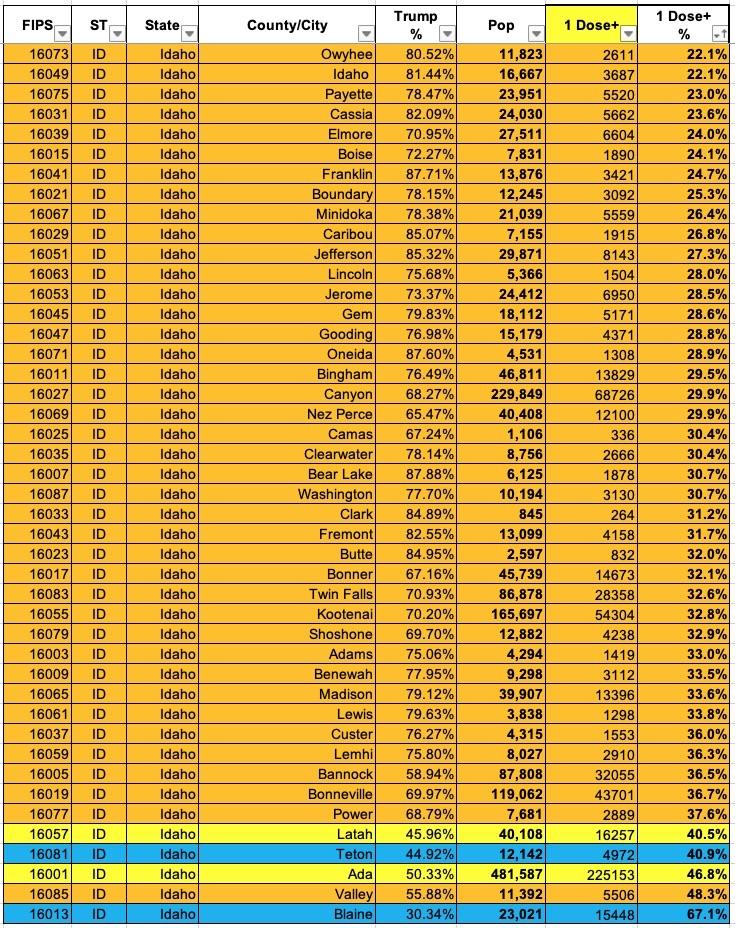
Now that I've developed a standardized format/layout & methodology for tracking both state- and county-level COVID vaccination levels by partisan lean (which can also be easily applied to other variables like education level, median income, population density, ethnicity, etc), I've started moving beyond my home state of Michigan.
NOTE: This is an updated version of a post from a couple of months ago. Since then, there's been a MASSIVELY important development: The passage of the American Rescue Plan, which includes a dramatic upgrade in ACA subsidies for not only the millions of people already receiving them, but for millions more who didn't previously qualify for financial assistance.
Much has been written by myself and others (especially the Kaiser Family Foundation) about the fact that millions of uninsured Americans are eligible for ZERO PREMIUM Bronze ACA healthcare policies.
I say "Zero Premium" instead of "Free" because there's still deductibles and co-pays involved, although all ACA plans also include a long list of free preventative services from physicals and blood screenings to mammograms and immunizations with no deductible or co-pay involved.
Much has been written by myself and others (especially the Kaiser Family Foundation) about the fact that millions of uninsured Americans are eligible for ZERO PREMIUM Bronze ACA healthcare policies.
I say "Zero Premium" instead of "Free" because there's still deductibles and co-pays involved, although all ACA plans also include a long list of free preventative services from physicals and blood screenings to mammograms and immunizations with no deductible or co-pay involved.
If you have a fairly healthy year, you really could go the entire year without paying a dime in healthcare costs while still taking advantage of many of these free services, and also having the peace of mind that in a worst-case scenario, at least you wouldn't go bankrupt. Not perfect, but a lot better than going bare especially since you wouldn't pay a dime in premiums.
Oklahoma Consumers to Have More Health Options for 2021 ACA Plans
OKLAHOMA CITY – Insurance Commissioner Glen Mulready announced today the 2021 preliminary rate filings for health insurance plans under the Affordable Care Act (ACA). Insurers that currently offer coverage through the Oklahoma Marketplace filed plans requesting average statewide increases of 2.7 percent.
Oklahoma Consumers to Have More Health Options for 2021 ACA Plans
OKLAHOMA CITY – Insurance Commissioner Glen Mulready announced today the 2021 preliminary rate filings for health insurance plans under the Affordable Care Act (ACA). Insurers that currently offer coverage through the Oklahoma Marketplace filed plans requesting average statewide increases of 2.7 percent.
The same three insurers that offered individual health plans on the 2020 Exchange will return for 2021 — Blue Cross Shield of Oklahoma (BCBSOK) , Bright Health and Medica Insurance Company. In addition, Oscar Health, UnitedHealthCare (UHC) and CommunityCare Oklahoma (CCOK) will join the marketplace in Oklahoma for 2021 allowing consumers to have more choices. BCBSOK and Medica offer statewide plans while Bright Health, CCOK, Oscar and UHC serve limited areas of the state.
Moderate rate increase requests and new insurers looking to offer plans in Oklahoma revealed that the Oklahoma insurance market is stable and able to offer multiple health insurance options for all Oklahomans.
On Tuesday, August 4, all Missourians will have the chance to vote Yes On 2 to bring more than a billion of our tax dollars home from Washington every year – money that’s now going to places like California and New York instead.
By bringing our tax dollars home, we can protect thousands of frontline healthcare jobs, help keep rural hospitals open, and deliver healthcare to Missourians who earn less than $18,000 a year. That includes thousands of veterans and their families, those nearing retirement, working women who don’t have access to preventive care, and other hardworking Missourians whose jobs don’t provide health insurance.
Back in 2018, I was all over the trend of deep red states putting ACA Medicaid expansion on the ballot after getting fed up with years of their elected leaders refusing to do so. Idaho, Utah and Nebraska voters all did exactly that, passing it by solid margins. Unfortunately, state Republicans got in the way (or at least tried to) in all three states, adding hurdles, barriers and caveats which have either delayed or partly weakened them.
In Red State Oklahoma, Medicaid Expansion Nears 2020 Ballot
A campaign in Oklahoma to expand Medicaid via the ballot box far eclipsed the necessary number of signatures needed to put the measure before voters next November 2020, supporters said Thursday.
The submission of 313,000 signatures to put a constitutional amendment on next year’s general election ballot shattered the required 178,000 needed by the Oklahoma Secretary of State’s office, organizers said. Media reports in Oklahoma said supporters of Medicaid expansion broke a state record when it comes to signatures needed for a statewide ballot initiative.
The recent elections in Virginia, Kentucky and Louisiana had two things in common: The first is that all three were huge victories for Democrats (they took control of both the state House and Senate in Virginia, flipped the Governor's seat in Kentucky and held onto it in deep red Louisiana).
The second is that all three elections were won in large part based on...Medicaid expansion.
Yet Edwards won, in large part, by also stressing his implementation of the Affordable Care Act’s Medicaid expansion in the state during his first term. Indeed, Edwards’s lead pollster, Zac McCrary, told me during an interview that no single issue was more important in driving the governor’s victory.