


2027 Rate Changes - Utah: +7.4% indy market; +10.4% sm. group market (FINAL)
Thu, 09/17/2026 - 3:01pm
Originally posted 8/17/26
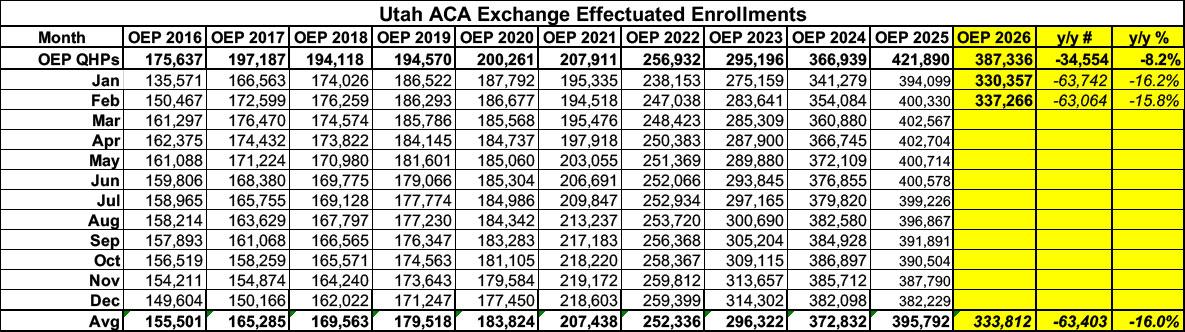
ACA exchange enrollment has dropped by 16% in Utah since Congressional Republicans allowed the enhanced federal subsidies to expire at the end of last year.
Initial signups during Open Enrollment were down 8% vs. OEP 2025...but the drop in effectuated enrollment doubled in the first two months of the year, to around 16% lower vs. the same point a year earlier.
That's over 63,000 Utahns who already lost coverage in just the first two months...a number which has likely continued to climb since then.
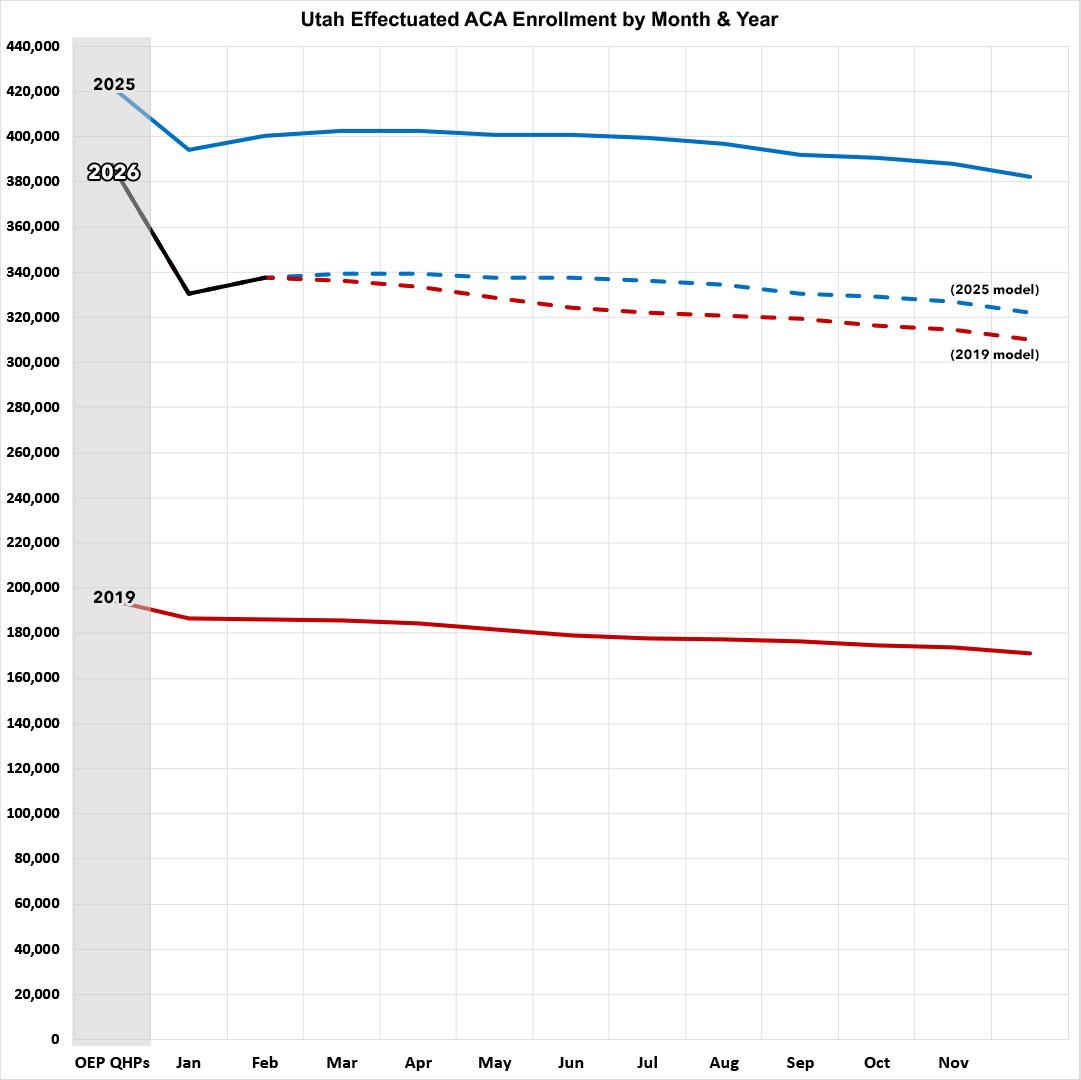
Here's what this looks like visually, with both 2025 and 2019 (the last pre-COVID year, which didn't include the enhanced subsidies) included for comparison:
Looking ahead to 2027, the preliminary rate filings for both the individual and small group markets are now available via both the federal Rate Review database as well as the Utah Insurance Dept's Rate Transparency Database:
BRIDGESPAN:
This filing proposes an average annual rate change of 7.5% at January 1, 2027, for the Individual line of business, as shown in “Exhibit A1: Development of 2027 Rate Change.” The 2027 projected average premium is $670.46 per member per month (PMPM).
The average annual rate change is calculated based on Individual enrollment data as of March 2026. A summary of the rate changes by plan is shown in “Exhibit D1: 2027 Average Change in Plan Base Rates.” In 2027, BridgeSpan is offering plans on the exchange.
Factor Changes
This filing includes updates to the plan and area factors. Rating factor tables and changes since the last filing are shown in the “Rate Manual” document. The average annual rate change impact of 7.5% includes the impact of these factor changes and is on a member-weighted basis. Plan pricing factors are updated using the most recent data and factors from the BridgeSpan pricing relativity model, with benefit design changes incorporated. Rate differences between plans reflect objective plan design differences and not differences in population morbidity.
Based on UID guidance, only on-exchange Silver plan premium should be increased to cover the additional costs associated with providing benefits to all Silver plan enrollees, in the event the CSR subsidies are not funded. See the “CSR Funding” section for more detail.
Area factors reflect relative cost differences between rating areas and, as required, do not include differences for population morbidity by geographic area. Area factors were updated to reflect relative cost differences between rating areas based on changes in unit cost and normalized PMPM claims cost.
Pool Base Rate Change
The pool base rate is $929.77 as of January 1, 2027, compared to $840.79 as of January 1, 2026. The pool base rate is the starting amount such that multiplying the base rate by the member’s rating factors (plan, age, area, and tobacco) and adjusting for family composition results in the member’s premium.
Reasons for Proposed Rate Change
Significant factors contributing to the proposed rate change: healthcare inflation and utilization increases, financial experience and increasing market morbidity.
Healthcare inflation and utilization increases: These adjustments refer to what is commonly known as healthcare trend. They reflect contractual changes in the carrier’s payments to healthcare providers and expected changes in the volume and types of services utilized by a carrier’s members.
Financial Experience: Each year BridgeSpan evaluates the most recent financial results in the Utah Individual market and incorporates that information into pricing. The experience also includes the impacts of pooling BridgeSpan with Regence BlueCross BlueShield of Utah (RBCBSU).
Market Morbidity Increase: BridgeSpan expects increased market morbidity due to the discontinuance of enhanced Premium Tax Credits as well as increased provider coding activity.
IMPERIAL HEALTH PLAN OF THE SW:
Scope and Range of the Rate Increase:
Imperial Insurance Companies, Inc. (Imperial) has submitted its 2027 filing for its Individual HMO product. The weighted average premium increase is 15.8%, with a minimum and maximum increase by plan of 9.9% and 21.31% respectively.
Key Drivers for this Filing
Changes in Medical Service costs:
A main driver of premium increases includes changes to anticipated medical costs and utilization of services. The estimated impact is approximately 11% to the filed increase. The main driver of trend are medical unit cost increases and pharmacy unit cost increases.
Changes in Benefits:
The 2027 premiums contain benefit changes including changes to:
- cost sharing provisions
- out of pocket maximums
MOLINA HEALTHCARE OF UT:
Reason for Rate Change(s): The following factors contribute toward the overall change in the proposed rates.
- Claims: Projected claims for 2027 are expected to contribute toward a [REDACTED] [REDACTED] in rates due to updated base period experience claims, trend, changes in product, acuity, and demographic mix.
- Taxes and Fees: Taxes, fees, and retention are expected to contribute toward a [REDACTED] [REDACTED] in rates.
- Margin: Margins are expected to contribute toward a [REDACTED] [REDACTED] in rates at our company standard [REDACTED] after-tax profit margin.
- Risk Transfer: Risk transfer is expected to contribute toward a [REDACTED] [REDACTED] in rates due to differences in actual versus expected risk transfer amounts for the 2025 benefit year and expected changes in 2027 population mix.
- Administrative Expenses: Administrative expenses are expected to contribute toward a [REDACTED] [REDACTED] in rates due to higher plan, corporate and QA expenses, offset by lower expected broker commissions.
- Membership Mix: The membership mix from the base period to the projection period compared to the membership mix for comparable time periods from the prior year rate filing is expected to contribute toward a [REDACTED] [REDACTED] in rates.
REGENCE BLUECROSS BLUESHIELD OF UT:
This filing proposes an average annual rate change of 3.9% at January 1, 2027, for the Individual line of business, as shown in “Exhibit A1: Development of 2027 Rate Change.” The 2027 projected average premium is $626.60 per member per month (PMPM).
The average annual rate change is calculated based on Individual enrollment data as of March 2026. A summary of the rate changes by plan is shown in “Exhibit D1: 2027 Average Change in Plan Base Rates.”
In 2027, RBCBSU is offering plans on and off the exchange.
This filing includes updates to the plan and area factors. Rating factor tables and changes since the last filing are shown in the “Rate Manual” document. The average annual rate change impact of 3.9% includes the impact of these factor changes and is on a member-weighted basis. Plan pricing factors are updated using the most recent data and factors from the RBCBSU pricing relativity model, with benefit design changes incorporated. Rate differences between plans reflect objective plan design differences and not differences in population morbidity.
Based on UID guidance, only on-exchange Silver plan premium should be increased to cover the additional costs associated with providing benefits to all Silver plan enrollees, in the event the CSR subsidies are not funded. See the “CSR Funding” section for more detail.
Area factors reflect relative cost differences between rating areas and, as required, do not include differences for population morbidity by geographic area. Area factors were updated to reflect relative cost differences between rating areas based on changes in unit cost and normalized PMPM claims cost.
Pool Base Rate Change
The pool base rate is $894.25 as of January 1, 2027, compared to $824.95 as of January 1, 2026. The pool base rate is the starting amount such that multiplying the base rate by the member’s rating factors (plan, age, area, and tobacco) and adjusting for family composition results in the member’s premium.
Reasons for Proposed Rate Change
Significant factors contributing to the proposed rate change: healthcare inflation and utilization increases, financial experience, increasing market morbidity, and changes in benefits.
Healthcare inflation and utilization increases: These adjustments refer to what is commonly known as healthcare trend. They reflect contractual changes in the carrier’s payments to healthcare providers and expected changes in the volume and types of services utilized by a carrier’s members.
Financial Experience: Each year RBCBSU evaluates the most recent financial results in the Utah Individual market and incorporates that information into pricing.
Market Morbidity Increase: RBCBSU expects increased market morbidity due to the discontinuance of enhanced Premium Tax Credits as well as increased provider coding activity.
Changes in Benefits: Each year RBCBSU evaluates the cost sharing features and benefits of each plan offering to determine the expected cost of incurred claims by plan.
SELECTHEALTH:
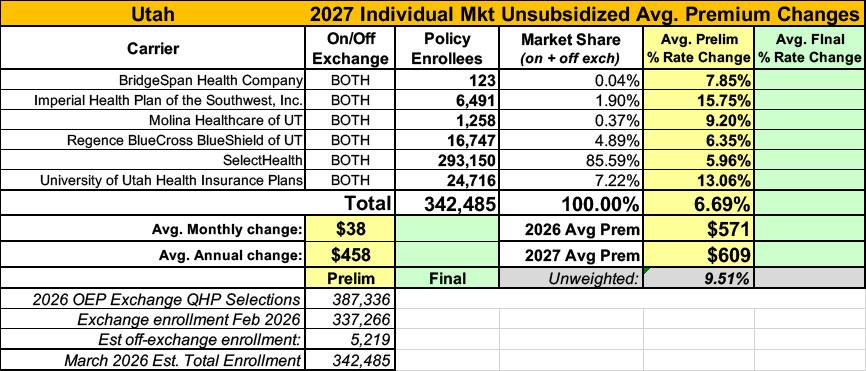
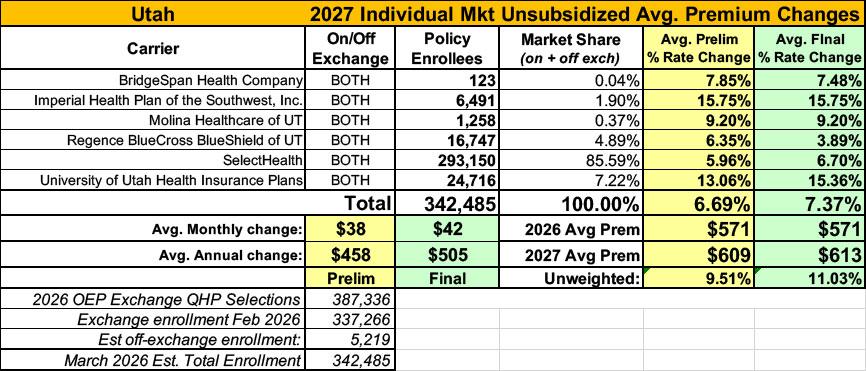
SelectHealth is offering products in the Individual ACA plan market in 2027. These plans will be available across all counties in Utah. The requested rate change will impact approximately 293,150 members and will vary depending on selected benefit, network, member’s age and geographic area. The 2027 average rate change is an increase of 5.96% with a minimum rate change of 4.26% and a maximum increase of 15.73%.
SelectHealth has a goal of affordability. Our teams, combining provider systems and a health plan, are working together to achieve this objective.
Contributing Factors
The rate change described above is driven by the following factors:
- The composition of the single risk pool
- Medical and pharmacy cost increases
1) The claims experience and health risk for the ACA risk pool continue to be high. Inflation and deductible leveraging are also increasing costs. 2) The utilization and costs for these plans are projected to increase for facility, provider and pharmacy claims.
Financial Experience
For 2025 calendar year, the average premium per member per month was $495.08. The average paid claims per member per month was $398.73. Administrative costs are 12.82% of premium (including taxes and fees) and the target for risk load is 3%.
UNIVERSITY OF UTAH HEALTH INSURANCE PLANS:
Section 2 – Scope and Range of Rate Increases
The overall weighted average 2027 premium rate increase is 13.06% for the 21,699 members enrolled in continuing plans. The proposed rate changes vary by metal tier and network. Members would receive premium rate changes ranging from 10.86% to 26.9% depending on their metal tier and network.
Section 3 – Financial Experience of the Product
For the most recent completed benefit year (2025), the total premium revenue was $583 per member per month (PMPM) plus $45 PMPM in risk adjustment premium revenue. The incurred medical claims were $612 PMPM prior to administrative costs, producing a Medical Care Ratio above the premium pricing target. Considering the rate increase for 2026, expected trends between 2025 and 2027, and impact from expiration of expanded APTCs, the premium increases are expected to keep the product in a net positive income position.
Section 4 – Changes in Medical Service Costs
The biggest factor in the rate increase is the increased claim costs and expected impact from the expected ending of expanded subsidies. UUHIP expects an average annual claim trend of 9.0% over the next two years.
Section 5 – Changes in Benefits
The plan benefits were changed to comply with allowed ranges in actuarial values (AV). The increase or decrease in AV is a factor in the rate increase or decrease. The AV change is not a large factor in the overall rate increases.
Section 6 – Administrative Costs and Anticipated Margins
The administrative costs assumptions and anticipated margins have increased as a percentage of claims from the prior filing and this change results in a 4.4% percent premium increase.
Overall, the weighted average rate increase being requested for 2027 by Utah ACA individual market carriers is a (relatively) "nominal" 6.7%. This gives Utah the 2nd-lowest average rate hikes so far on a percentage basis behind Vermont's 6.5% increase...except that Vermont is starting out with average premiums over $1,000/month per enrollee, while Utah has the 4th-lowest baseline for 2026 at $571/month on average.
This means that unsubsidized enrollees in Utah will "only" be paying around $38 more per month on average, or an extra $458/year each.
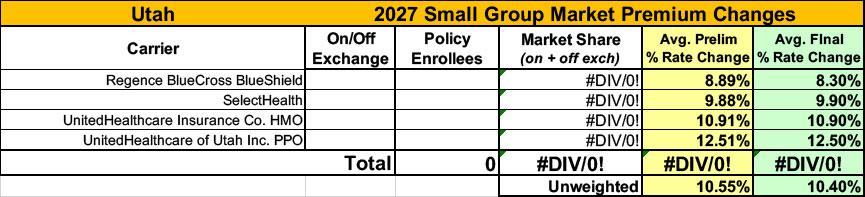
As for the small group market, I wasn't able to acquire the active enrollment data for any of Utah's four carriers, so the unweighted average increase is around 10.6%:
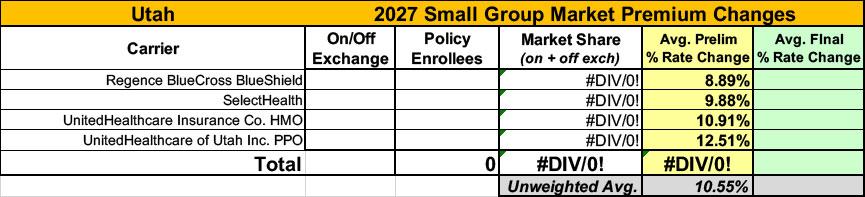
UPDATE 9/17/26: The Utah Insurance Dept. has published the final, approved rate filings for the 2027 individual and small group markets. Overall, only small changes were made, but the result is that the weighted average rate hikes on the individual market increased slightly from 6.7% to 7.4%, while being slightly lower for small group plans (from 10.6% to 10.4%)
Advertisement


