


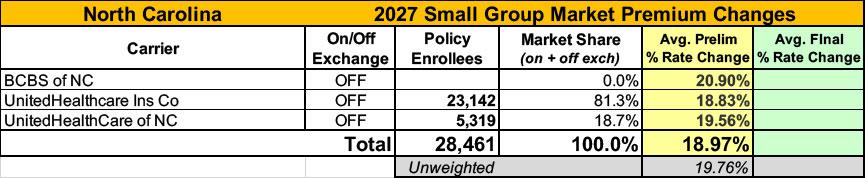
2027 Rate Changes - North Carolina: +14.9% indy market; +19.8% sm. group market
Mon, 08/10/2026 - 8:51pm
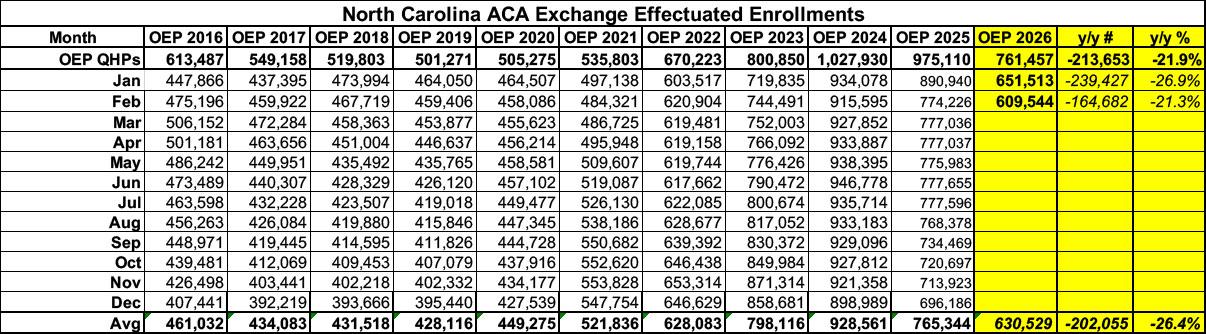
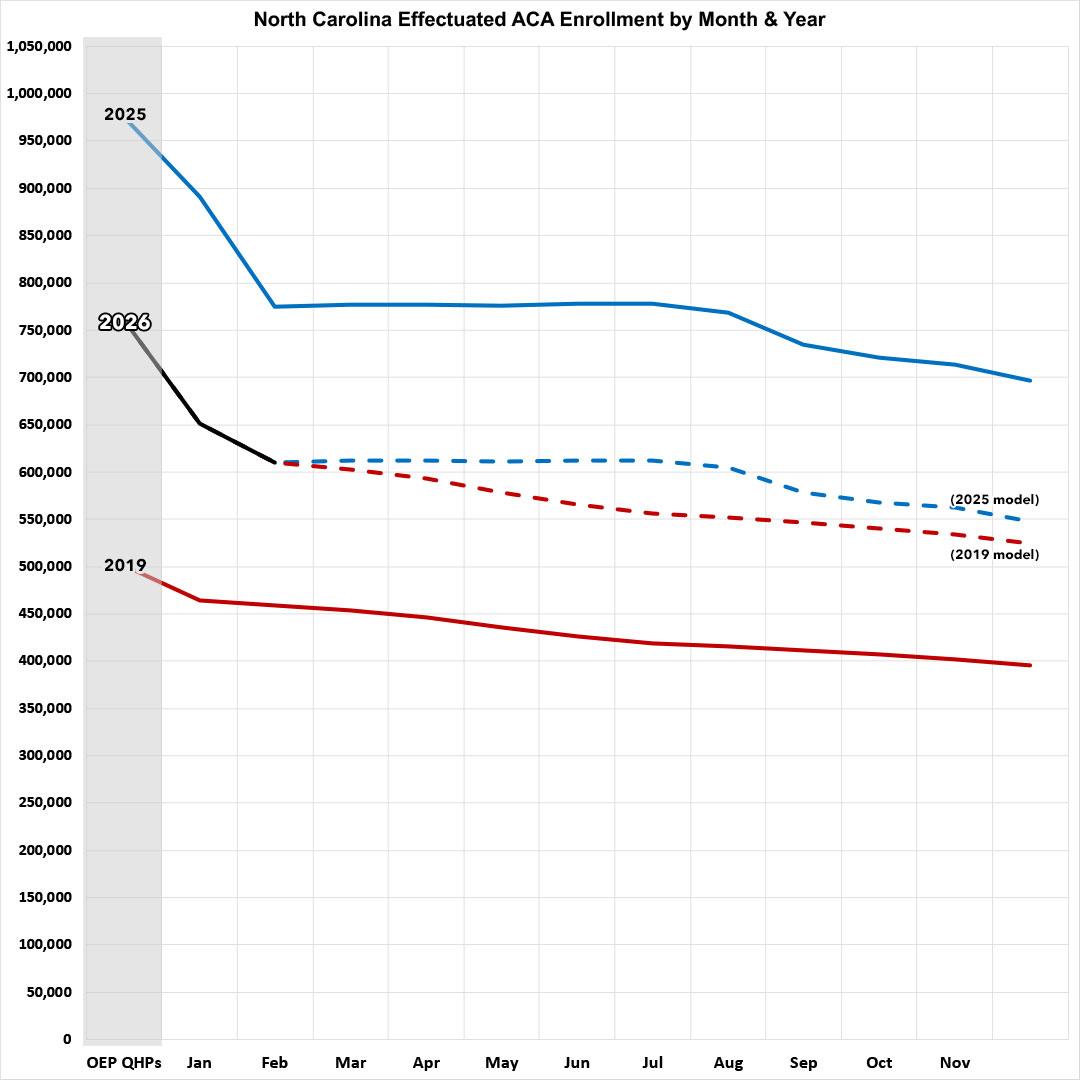
ACA exchange enrollment has dropped by more than 26% in North Carolina since Congressional Republicans allowed the enhanced federal subsidies to expire at the end of last year.
Technically speaking, the year over year drop was as high as 27% in January due to an oddly sharp effectuated enrollment drop in January 2025...but over the first two months of 2026 this averages out to a hair over 200,000 North Carolinians losing coverage in just the first two months of the year:
Here's what this looks like visually, with both 2025 and 2019 (the last pre-COVID year, which didn't include the enhanced subsidies) included for comparison:
Looking ahead to 2027, the preliminary rate filings for both the individual and small group markets are now available via the federal Rate Review database.
AMBETTER OF NC:
Ambetter of North Carolina Inc. is filing rates for the individual block of business, effective January 1, 2027. This document is submitted in conjunction with the Part I Unified Rate Review Template and the Part III Actuarial Memorandum.
This information is intended for use by the North Carolina Department of Insurance, the Center for Consumer Information and Insurance Oversight (CCIIO), and health insurance consumers in North Carolina to assist in the review of Ambetter of North Carolina Inc.’s individual rate filing.
The results are actuarial projections. Actual experience will differ for a number of reasons, including population changes, claims experience, and random deviations from assumptions. In 2025, earned premium was $589.28 per member per month (PMPM). Incurred claims in 2025 were $434.46, or 73.73% of premium. Netting risk adjustment from the claims results in an estimated loss ratio (incurred claims net of estimated risk adjustment transfers, divided by earned premiums) of 76.17%. We expect unit costs to increase for 2027. Further, we have updated underlying experience for the single risk pool, expected administrative expense, and assumptions for federal risk adjustment. These factors, as well as changes to the assumed morbidity of the single risk pool and medical trend, result in a premium rate increase.
Medical trend, or the increase in health care costs over time, is composed of two components: the increase in the unit cost of services and the increase in the utilization of those services. Unit cost increases occur as care providers and their suppliers raise their prices. Utilization increases can occur as people seek more services than before. Additionally, simple services can be replaced with more complex services over time, which is known as service intensity trend. An example of service intensity trend would be the replacement of an X-ray with an MRI scan. Replacing the service with a more intense service causes the total cost of medical services to increase.
The proposed rate change of 8.5% applies to approximately 200,423 individuals. Ambetter of North Carolina Inc.’s projected administrative expenses for 2027 are $96.40 PMPM. Administrative expense does not include $26.13 for taxes and fees. The historical administrative expenses for 2026 were $87.20 PMPM, which excludes taxes and fees. The projected loss ratio is 82.0% which satisfies the federal minimum loss ratio requirement of 80.0%.
BLUE CROSS BLUE SHIELD OF NC:
Blue Cross and Blue Shield of North Carolina (Blue Cross NC) has submitted a request to the North Carolina Department of Insurance seeking approval for premium rate adjustments to its fully ACA-compliant individual health plan offerings. The proposed filing reflects an average rate increase of 17.7%, excluding the effects of member aging, effective January 1, 2027. At the individual plan level, renewal rate changes range from 7.8% to 22.9%. Actual premium changes for subscribers may vary based on factors such as geographic location, age, dependent coverage, and other rating variables.
Financial Experience of the Product
These rates are designed to achieve a Medical Loss Ratio (MLR) of at least 80%, in line with the requirements for individual ACA health plans. Under the Affordable Care Act (ACA), health insurers must allocate a minimum of 80% of premium revenue toward medical care and activities that enhance healthcare quality for members. If the actual MLR falls below this threshold, rebates will be issued to policyholders as mandated by law.
Drivers of Rate Increase
The main reasons for the premium increase are rising health care costs in this ACA-compliant block.
These higher costs come primarily from three areas:
1. 2. 3. Higher prices for medical services—especially from hospitals, doctors, and pharmacies—driven by things like new technology and expensive specialty drugs.
Increased use of health care services by members which is influenced by how people use and select plans in the ACA market.
Expiration of the enhanced premium tax credits (eAPTCs), 2027 NBPP, and H.R.1 —The elimination of the eAPTCs combined with NBPP and H.R.1 regulatory changes is expected to result in continued membership decline in the individual ACA market, resulting in increases to morbidity and operating expenses on a per member basis.
Efforts to Control Costs
Blue Cross NC is committed to keeping insurance costs affordable and supporting the ong-term stability of the individual ACA market. We’re building innovative partnerships with providers, securing better hospital discounts, developing early intervention programs to improve health outcomes and reduce costly treatments, and equipping members with tools to make informed care decisions.
CIGNA:
Dear Commissioner Causey:
This letter serves as formal notice that Cigna Healthcare of North Carolina (Cigna Healthcare) intends to discontinue offering individual medical insurance coverage in the State of North Carolina, effective January 1, 2027. Subject to the Department’s review, Cigna Healthcare will issue the required advance notices of discontinuation to all affected covered individuals in compliance with applicable North Carolina and federal law. Cigna Healthcare will continue to offer individual dental market coverage in North Carolina. The details of Cigna Healthcare’s individual medical market discontinuation are as follows:
• Number of Lives Impacted: 16,006 (including on-exchange and off-exchange enrollment)
- Product Forms Impacted: CCGH-134521344 (Forms), CCGH-134682442 (Rates), and CCGH-NC26-125120430 (Binder)
- Effective Date of Non-Renewal: January 1, 2027
- Line of Business: Individual Medical HMO
Cigna Healthcare will comply with the discontinuation and uniform termination requirements set forth in N.C. Gen. Stat. § 58-68-65, including the requirement to provide written notice to covered individuals at least 180 days prior to the discontinuation date. Draft member notices are included in this filing and will be issued no later than July 1, 2026.
Cigna Healthcare acknowledges that, pursuant to N.C. Gen. Stat. § 58-68-65(c), an issuer that discontinues all individual market coverage is subject to the statutory restrictions on reentering the individual market following the effective date of discontinuation.
Please contact me if you have any questions or require additional information regarding this filing.
OSCAR HEALTH PLAN OF NC:
The purpose of this document is to present rate change justification for Oscar Health Plan of Pennsylvania, Inc (Oscar’s) Individual Affordable Care Act (ACA) products, with an effective date of January 1, 2027, and to comply with the requirements of Section 2794 of the Public Health Service Act as added by Section 1003 of the Patient Protection and Affordable Care Act (ACA).
Using in-force business as of March 2026, the proposed average rate increase for renewing plans is 18.0%. Rate increases vary by plan due to a combination of factors including shifts in benefit leveraging and cost-sharing modifications. This rate increase is absent of rate changes due to attained age. The rate increase impacts an estimated 61,194 members.
2. Reason for Rate Increase(s)
The significant factors driving the proposed rate change include the following:
Medical & Prescription Drug Inflation and Utilization Trends
The projected premium rates reflect the most recent emerging experience which was trended for anticipated changes due to medical and prescription drug inflation and utilization.
Administrative Expenses, Taxes and Fees and Risk Margin
Changes to the overall premium level are needed because of required changes in federal and state taxes and fees. In addition, there are anticipated changes in both administrative expenses and targeted risk margin.
Prospective Benefit Changes
Plan benefits have been revised as a result of changes in the Center for Medicare and Medicaid Services (CMS) Actuarial Value Calculator and state requirements, as well as for strategic product considerations.
Anticipated Changes in the Average Morbidity of the Covered Population
Changes to the overall premium level are needed because of anticipated changes in the underlying morbidity of the projected marketplace.
Anticipated Changes in the Network Configuration
Changes to the overall premium level are needed because of anticipated changes in the underlying network configuration and associated unit costs.
UNITEDHEALTHCARE OF NC:
UHC is filing 2027 rates for individual products. The proposed rate change is [Redacted: TRADE SECRET] and will affect [Redacted: TRADE SECRET] individuals. The rate changes vary between [Redacted: TRADE SECRET] and [Redacted: TRADE SECRET]. Given that the rate changes are based on the same single risk pool, the rate changes vary by plan due to plan design changes.
Financial Experience of the Product
The premium collected in plan year 2025 was [Redacted: TRADE SECRET]. Incurred claims during this period were [Redacted: TRADE SECRET] and UHC expects to [Redacted: TRADE SECRET] for risk adjustment. The loss ratio, or portion of premium required to pay medical claims, for plan year 2025 is [Redacted: TRADE SECRET].
Changes in Medical Service Costs
There are many different healthcare cost trends that contribute to increases in the overall U.S. healthcare spending each year. These trend factors affect health insurance premiums, which can mean a premium rate increase to cover costs. Some of the key healthcare cost trends that have affected this year’s rate actions include:
- Increasing cost of medical services: Annual increases in reimbursement rates to healthcare providers, such as hospitals, doctors, and pharmaceutical companies.
- Increased utilization: The number of office visits and other services continues to grow. In addition, total healthcare spending will vary by the intensity of care and use of different types of health services. The price of care can be affected using expensive procedures such as surgery versus simply monitoring or providing medications.
- [Redacted: TRADE SECRET]
- [Redacted: TRADE SECRET]
Changes in Benefits
There were no significant changes in the benefits offered by UHC’s plans.
Administrative Costs and Anticipated Margins
UHC works to directly control administrative expenses by adopting better processes and technology and developing programs and innovations that make healthcare more affordable. We have led the marketplace by introducing key innovations that make healthcare services more accessible and affordable for customers, improve the quality and coordination of healthcare services, and help individuals and their physicians make more informed healthcare decisions.
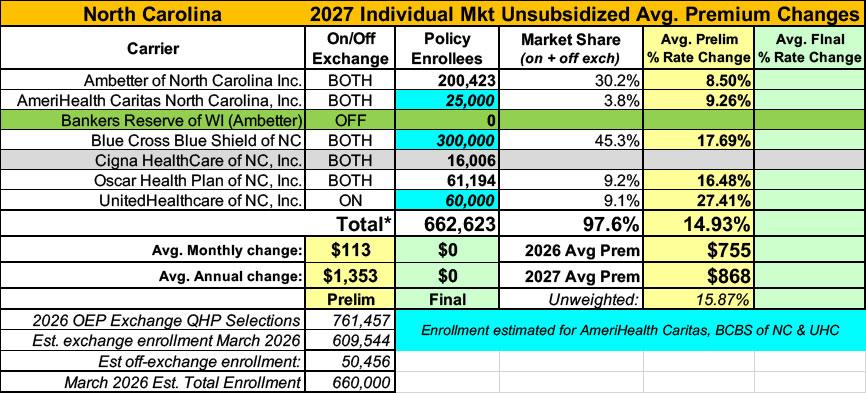
Unfortunately, while the preliminary rate increase filings are available for all five of the carriers which are participating in the NC individual market both this year and next (CIgna, which has 16,000 enrollees, is leaving the entire ACA market, while Bankers Reserve (Ambetter) is newly joining the NC market), I only have effectuated enrollment data for two of those five.
For the remaining three, I've had to make rough guesstimates based on last year's enrollment data, the confirmed February 2026 on-exchange effectuated enrollment and an assumption that perhaps 10% of the total is off-exchange, along with rough 2027 projections from the NC Insurance Dept.
Overall I'm assuming total effectuated enrollment as of March 2026 was roughly 660,000 people, and I'm assuming the "missing" ~375,000 break out roughly as follows: ~25K AmeriHeatlh Caritas; ~300K BCBS NC; ~60K UnitedHealthcare of NC.
Assuming I'm roughly close on these, the semi-weighted average 2027 rate increase would be around 14.9%, give or take:
North Carolina's small group market carriers, meanwhile, are all seeking 2027 rate hikes of roughly 20%:
Advertisement


